Saturday, August 12, 2023

For All Time: The Victorian Gift Book

 This essay was originally published on the blog of the American Bookbinders Museum.

01_jo_writing

“Jo was the first to wake in the gray dawn of Christmas morning. No stockings hung at the fireplace and for a moment she felt as much disappointed as she did long ago, when her little sock fell down because it was crammed so full of goodies. Then she remembered her mother’s promise and, slipping her hand under her pillow, drew out a little crimson-covered book. She knew it very well, for it was that beautiful old story of the best life ever lived, and Jo felt that it was a true guidebook for any pilgrim going on long journey. She woke Meg with a “Merry Christmas,” and bade her see what was under her pillow. A green-covered book appeared, with the same picture inside….Presently Beth and Amy woke to rummage and find their little books also, one dove-colored, the other blue, and all sat looking at and talking about them while the east grew rosy with the coming day.” (Louisa May Alcott, Little Women)

02_title page_little women

It would be easy to assume that the impoverished March girls have received bibles as their only Christmas present. However, it is likely their mother may have provided them with a book of scriptural readings designed for young people. (The Marches would have possessed one family bible.) There were many such volumes among the plethora of books brought to market during the 19th century in England and American specially designed as gifts-to-be-given for the holiday season.

Newspapers of the day devoted columns to advertising these products during the season. For example, the Boston Post of December 18th, 1850 advertised the following:

Superb New Illustrated Works for Christmas and New Year’s Presents

Just published by D. Appleton & Co. 200 Broadway

1.Our Savior, with Prophets and Apostles

A series of Eighteen highly finished Engravings, designed expressly for this work, with descriptions by several American Divines. Edited by J.M. Wainwright, D.D. One volume imperial octavo, in the following varieties of binding:

Emblematic, with raised figure of our Lord, $7; Superantique beveled morocco extra, $10; Do col’d $15 [the same, colored]; Do. do. with miniature painting on each style of binding, on plate glass in centre, $15; Do, col’d $20; Do. Do. Papier mache framed in beveled morocco $12; Do. Col’d $18; Do. Plate glass, with superb painting on whole of sides, $25.

The publisher offers the book in a range of binding styles to suit every pocketbook; it is entirely possible that Marmee March, despite straitened circumstances, might have procured a simpler version of this book or something similar for her girls.

Beauty Inside and Out

Note that the advertisement above touts the high quality illustrations of the volume; gift books inevitably were illustrated with either wood cuts, steel engravings or both. New technology available after about 1810 made intricate steel cut engravings affordable to the masses.

The advertiser goes on to praise both the outer beauty of the book and the intrinsic value of its contents:

We can scarcely conceive of a work more commendable as a gift book, its interior and exterior being alike attractive to any person of pure and elevated taste. There is nothing ephemeral or perishable about it…it is a book, not for a season, for all time.

The clever copywriter has summed up the essence of the Victorian gift book: it was a status symbol for an increasingly literate population, first in England, in the first part of the century and then later in the United States. Elegant gift books made the perfect present for anyone aspiring to “pure and elevated taste.”

Whether read or not, a beautifully bound book could be shown off in the parlor; it was the coffee table book of the times. (One supposes that books bound with glass plates, as mentioned in the advertisement, were intended largely for display.) Lavishly produced gift books might have included ornate or embossed cloth, silk, or leather, a decorative frontispiece and end papers, an engraved presentation plate at the front, gilt edges, and a number of fine illustrations with hand-inserted tissue paper protectors. The volume might have had its own casing to keep it pristine. All of this was made possible by advances in machine-embossing, book stamping, engraving, and color lithography. Although machines made this luxury affordable for the middle class, the process of creating high end gift books was still very labor-intensive.

forget me not 1824

(photo via the University of Virgina/Albert & Shirley Small Special Collections Library)

Between the covers

Of course, any type of book could be elegantly bound and presented as a gift. However, the gift book phenomenon truly took off when publishers competed for the public dollar by commissioning anthologies of verse, short stories, moral essays, and original artwork.

A special type of gift book was the annual – an anthology of writings and original artwork artfully bound and printed, with the year stamped on the cover. These volumes were released to the public in months prior to the cover date, in order to be given as holiday gifts. They were also sold throughout the year for use as prizes in school competitions or to commemorate birthdays and anniversaries. Sub-categories of annuals included volumes for children, those espousing the abolitionist cause, and others representing various charities. A popular annual would appear in new editions for several years.

The desire for new material for these literary compilations was a boon to aspiring authors stateside. New writers might see their work published alongside established authors such as Longfellow, Hawthorne, and Emerson. In deference to the “pure and elevated taste” of the American reading public (particularly women), much of the content featured in anthologies was overly sentimental or romance based. In contrast, a portion of writing was given over to more meaty subjects, including mystery and horror (both Sir Arthur Conan Doyle and Edgar Allen Poe contributed stories to gift books.) Atypical of these volumes was any actual Christmas content — these were books for Christmas, not about Christmas.

Image taken from The Girl's Own Annual 1887, pages 483-484. Parker Collection of Children's Books BQ 0871.1 699955

(photo from The Library of Birmingham’s copy of The Girl’s Own Annual 1887, pages 483-484. Parker Collection of Children’s Books BQ 0871.1 699955)

While they were a target audience for gift books, women also found their place as writers and editors for many of these publications; Mary Shelley and Harriet Beecher Stowe both contributed to annuals over the course of their careers.

Jo March, herself, (a thinly disguised Louisa May Alcott), helped her family by writing sensational short stories for public consumption:

“She…began to feel herself a power in the house, for by the magic of a pen, her “rubbish” turned into comforts for them all. The Duke’s Daughter paid the butcher’s bill, A Phantom Hand put down a new carpet, and the Curse of the Coventrys proved the blessing of the Marches in the way of groceries and gowns.”

04_forget me not 1822

A British literary “Annual” for 1823, this Forget-me-Not was published late in 1822 for the holiday market. Many annuals had sentimental names evoking their character as gifts: The Gift, The Token, The Talisman, The Keepsake, to name a few. Illustrations with classical or romantic themes were typical. (photo from Wikipedia.)

05_lady of the lake

This edition of the beloved Scott poem displays the elegant binding of a high-end gift book. The Lady of the Lake, originally published in 1810, became a favorite gift book on both sides of the pond. The gold stamped cover includes the bookbinder’s initials (JL for John Leighton) within the centerpiece, indicating that he had standing above the usual bookbinders and artists who toiled to make these works of art. Unlike most gift books, this 1863 volume includes actual photographs. Image courtesy of Echoes from the Vault, a blog of the Special Collections at the University of St. Andrews, Scotland.

06-altemus_binder_christmas blossom

This American gift annual, the Christmas Blossom (1849) features gold stamping on blue rib-grain cloth. The words “Altemus Binder,” not visible here, are inserted into the garland at bottom left. From the website Publishers Binding Online 1815-1930: The Art of the Book.

Further suggested reading:

A great deal has been written on the subject of gift books, annuals, and their cousins, much of it quite academic. If you’re not particularly interested in exploring the “objective correlative” or “blurred lines of the vignette,” I recommend the following:


— Eleanor Boba


Tuesday, August 8, 2023

Stacking the Deck: A Playing Card Press

This essay was originally published on the blog of the American bookbinders museum

For centuries people have employed “presses” of various types to protect and preserve precious possessions. Victorian women pressed flowers given them by admirers. Linen presses and clothes presses, generally now synonymous with cupboards, originally were devices to flatten fine fabrics via a platen and large screw, not unlike printing presses. Today collectors often turn to specialized pressing services to improve the condition of their vintage comic books!

Recently a fan called our attention to yet another pressing problem: the preservation of decks of playing cards from the 18th and 19th centuries. Before the advent of plasticized or laminated playing cards, these popular playthings were made of thin cardboard, highly vulnerable to damage from tearing, curling, and warping. In addition, before the age of mass production, playing cards were no trivial expense. Hence the role of the playing card press — a small, fairly simple device designed to hold one’s playing card deck flat and protected.

Card press 1

Laura Bullock of Hyde Park, New York, shared with us photos of an antique playing card press she acquired at a local shop, Hyde Park Consignments. The little wooden press measures 8 ¾ inches by 3 7/8 inches wide, big enough for two decks, with two dowel screws projecting from the top. The apparatus had been acquired by the shop in company along with two decks of vintage playing cards.

card press 2

Bullock’s simple two-deck press is made of wood and features two dowels to apply even pressure on the cards. Other vintage presses might be made of metal and highly ornamented. Some, designed for a single deck, employed one central screw.

card press 3


A card deck that came with the press exhibits the insignia of S.D. Modiano, an Italian printer which began by making cigarette papers and moved on to the lithographic printing of playing cards in 1884. A tax stamp also appears on the cover card.

Modern, acrylic or steel versions of the playing card press are still manufactured — used largely by magicians! These generally have at least six screws or operate on a clamp system.

Today vintage card presses are best used as attractive conversation pieces. Some may be repurposed for use as, say, flower presses. In the 1930s a creative inventor petitioned for a patent for a combined nutcracker and playing card press. No word on whether he cracked the market.

— Eleanor Boba


Monday, August 7, 2023

Spellbinding: Works of Magic in Fantasy Literature


5-witches-and-demons


This essay was first published on the blog of the American bookbinders museum

They bought Harry’s school books in a shop called Flourish and Blotts where the shelves were stacked to the ceiling with books as large as paving stones bound in leather; books the size of postage stamps in covers of silk; books full of peculiar symbols and a few books with nothing in them at all. (Harry Potter and the Sorcerer’s Stone)


Books of magic and magical books are staples in fantasy and horror literature. With no physical laws to inhibit them, what flights of fancy may authors not conjure up to enchant us?

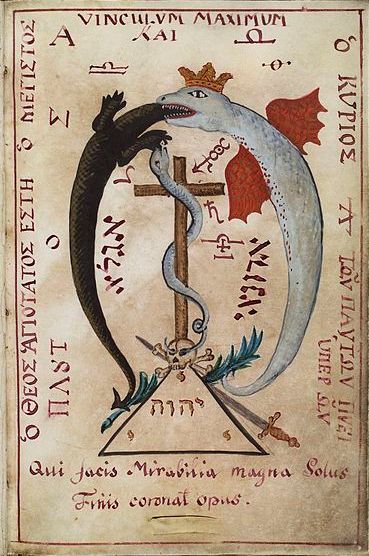
A page of the legendary Cyprianus, or “Black Book.” 18th Century. Latin, Greek, and Hebrew text appears on the page, alongside obscure symbols. Some say the text of the book was meant to be read backwards. Courtesy of Wellcome Images.

A page of the legendary Cyprianus, or “Black Book.” 18th Century. Latin, Greek, and Hebrew text appears on the page, alongside obscure symbols. Some say the text of the book was meant to be read backwards. Courtesy of Wellcome Images.

The granddaddy of mystical tomes is the Necronomicon, an invention of horror writer H.P. Lovecraft (1890-1937) which he employed in a number of his short stories and novels. Lovecraft endowed his grimoire (a book of magical spells and talismans) with such a detailed history that many folk have believed it real. Stories abound of library patrons requesting access to the “worm-riddled volume.”

Lovecraft’s descriptions of the physical book are more evocative than detailed:

[He] appeared one day in Arkham in quest of the dreaded volume kept under lock and key at the college library – the hideous Necronomicon of the mad Arab Abdul Alhazred in Olaus Wormiu’s Latin version, as printed in Spain in the seventeenth century. (“The Dunwich Horror”)

Another literary grimoire appears in the novel and musical Wicked.* Author Gregory Maguire (b. 1954) details both the binding and content of the Grimmerie which Elphaba consults for useful spells and information:

She went to the Grimmerie and hauled open its massive cover – leather ornamented with golden hasps and pins, and tooled with silver leaf – and pored through the tome to find what makes people thirst for such authority and muscle.

The Grimmerie described poisoning the lips of goblets, charming the steps of a staircase to buckle, agitating a monarch’s favorite lapdog to make a fatal bite in an unwelcome direction.

There were elegant attenuated drawings in blood red and gold leaf, on the front and rear elevations of (it seemed) an angel, with notes in a fine hand on the aerodynamic aspects of holiness. The wings flexed up and down and the angel smiled with a saucy sort of sanctity. “And a recipe on this page. It says ‘of apples with black skin and white flesh: to fill the stomach with greed unto Death.”

The Grimoire of Pope Honorius, an 18th century book named for 13th century pope.

The Grimoire of Pope Honorius, an 18th century book named for 13th century pope.

MOVABLE TYPE

The best examples of literary spell books play on the tradition of the written word as imbued with magic. Pre-literate populations looked on both writing and reading with deep suspicion and it is no coincidence that the word for casting an enchantment is “spell.”

Elphaba’s Grimmerie is clearly an enchanted book meant only for the serious reader. The witch herself must work to understand it:

“Look how it scrambles itself as you watch.” She pointed to a paragraph of hand-lettered text. Sarima peered. Though her skill at reading was minimal, she gaped at what she saw. The letters floated and rearranged themselves on the page, as if enlivened. The page was changing its mind as they watched it. The letters clotted together in a big black snarl, like a mound of ants.”

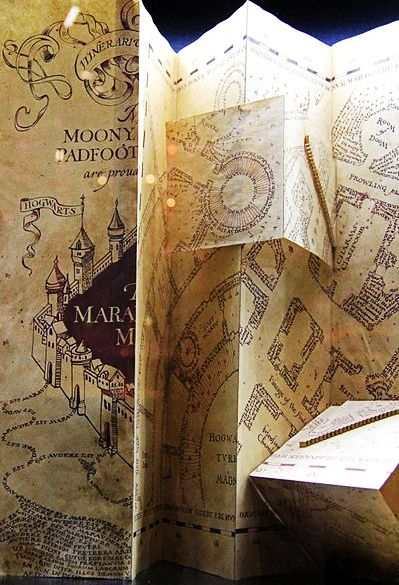
A similar device is used in the Harry Potter books of J.K. Rowling (b. 1965), books filled with enchanted books, parchments, letters, and other printed objects. Those who have read the books or seen the movies well know that in Harry’s magical world pictures come alive. So does a document known as The Marauder’s Map. The map has the appearance of a “square, very worn piece of parchment with nothing written on it” until it is touched by a magician’s wand and given a command, usually “I solemnly swear that I am up to no good.” It then reveals its true purpose:

It was a map showing every detail of the Hogwarts castle and grounds. But the truly remarkable thing were the tiny ink dots moving around it, each labeled with a name in minuscule writing. Astounded, Harry bent over it. A labeled dot in the top left corner showed that Professor Dumbledore was pacing his study; the caretaker’s cat, Mrs. Norris, was prowling the second floor; and Peeves the Poltergeist was currently bouncing around the trophy room. (Harry Potter and The Prisoner of Azkaban)

The Marauder’s Map, a prop from the Harry Potter films. Posted to Flickr by Karen Roe.

The Marauder’s Map, a prop from the Harry Potter films. Posted to Flickr by Karen Roe.

Text that moves or changes, appears or disappears is the very stuff of occult fiction. Horror writer M.R. James (1862-1936) uses mystical text frequently in his short satires – a bit of Latin schoolwork with an ominous message which disappears after reading, a slip of paper with runic symbols and a death wish, a scrapbook of medieval manuscripts that imprisons a fearful demon, a will that translates itself from an unknown language to English when in the right hands.**

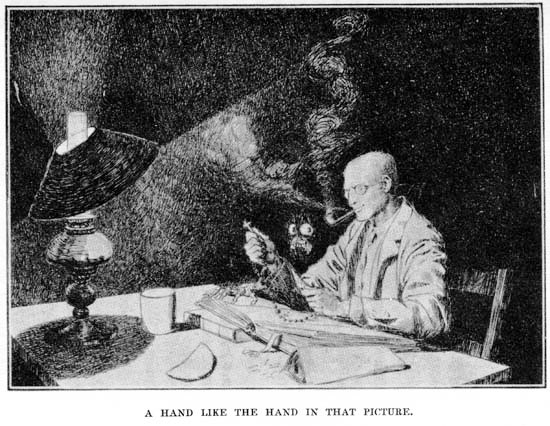
An illustration from an early printing of M.R. James’ “The Scrapbook of Canon Alberic.”

An illustration from an early printing of M.R. James’ “The Scrapbook of Canon Alberic.”

The esoteric nature of magical documents requires that they be difficult to interpret. While the Grimmerie employs movable type and The Marauder’s Map is cloaked in invisibility, other magical books are written in ancient – preferably dead – languages: Latin, Greek, Ancient Hebrew and Arabic are favorites; others are written in code.

Perhaps the most unusual literary spell book appears in Jonathan Strange & Mr. Norell by Susanna Clarke, a novel crammed full of books of magic. The chief among these, the Book of the Raven King, is found written indelibly on the body of a beggar. The text, present from birth, is heavily symbolic, seemingly indecipherable, and subject to alteration:

“I have changed! said Vinculus. “Look!” He took off his coat and opened his shirt. “The words are different! On my arms! On my chest! Everywhere! This is not what I said before!” …..

“So what are you now?”

Vinculus shrugged his shoulders. “Perhaps I am a Receipt-Book!*** Perhaps I am a Novel! Perhaps I am a Collection of Sermons!”

“I hope you are what you have always been – a Book of Magic. But what are you saying? Vinculus, do you mean to tell me that you never learnt these letters?”

“I am a Book,” said Vinculus, stopping in mid-caper. “I am the Book. It is the task of the Book to bear the words. Which I do. It is the task of the Reader to know what they say.”


Fortunately, we readers may leave the burden of interpretation to the authors, sit a spell, and enjoy the story.

ॐ

*The novel is subtitled “The Life and Times of the Wicked Witch of the West;” the musical is subtitled “The Untold True Story of the Witches of Oz.”

**From “A School Story,” “Casting of the Runes,” “The Scrapbook of Canon Alberic,” and “The Tractate Middoth,” respectively

***A recipe book