Showing posts with label Halloween. Show all posts

Monday, August 7, 2023

Spellbinding: Works of Magic in Fantasy Literature


5-witches-and-demons


This essay was first published on the blog of the American bookbinders museum

They bought Harry’s school books in a shop called Flourish and Blotts where the shelves were stacked to the ceiling with books as large as paving stones bound in leather; books the size of postage stamps in covers of silk; books full of peculiar symbols and a few books with nothing in them at all. (Harry Potter and the Sorcerer’s Stone)


Books of magic and magical books are staples in fantasy and horror literature. With no physical laws to inhibit them, what flights of fancy may authors not conjure up to enchant us?
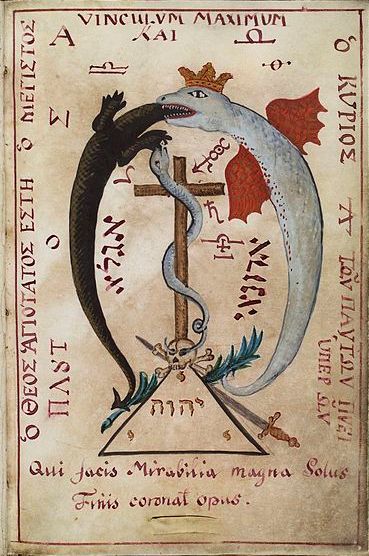
A page of the legendary Cyprianus, or “Black Book.” 18th Century. Latin, Greek, and Hebrew text appears on the page, alongside obscure symbols. Some say the text of the book was meant to be read backwards. Courtesy of Wellcome Images.

A page of the legendary Cyprianus, or “Black Book.” 18th Century. Latin, Greek, and Hebrew text appears on the page, alongside obscure symbols. Some say the text of the book was meant to be read backwards. Courtesy of Wellcome Images.

The granddaddy of mystical tomes is the Necronomicon, an invention of horror writer H.P. Lovecraft (1890-1937) which he employed in a number of his short stories and novels. Lovecraft endowed his grimoire (a book of magical spells and talismans) with such a detailed history that many folk have believed it real. Stories abound of library patrons requesting access to the “worm-riddled volume.”

Lovecraft’s descriptions of the physical book are more evocative than detailed:

[He] appeared one day in Arkham in quest of the dreaded volume kept under lock and key at the college library – the hideous Necronomicon of the mad Arab Abdul Alhazred in Olaus Wormiu’s Latin version, as printed in Spain in the seventeenth century. (“The Dunwich Horror)

Another literary grimoire appears in the novel and musical Wicked.* Author Gregory Maguire (b. 1954) details both the binding and content of the Grimmerie which Elphaba consults for useful spells and information:

She went to the Grimmerie and hauled open its massive cover – leather ornamented with golden hasps and pins, and tooled with silver leaf – and pored through the tome to find what makes people thirst for such authority and muscle.

The Grimmerie described poisoning the lips of goblets, charming the steps of a staircase to buckle, agitating a monarch’s favorite lapdog to make a fatal bite in an unwelcome direction.

There were elegant attenuated drawings in blood red and gold leaf, on the front and rear elevations of (it seemed) an angel, with notes in a fine hand on the aerodynamic aspects of holiness. The wings flexed up and down and the angel smiled with a saucy sort of sanctity. “And a recipe on this page. It says ‘of apples with black skin and white flesh: to fill the stomach with greed unto Death.”

The Grimoire of Pope Honorius, an 18th century book named for 13th century pope.

The Grimoire of Pope Honorius, an 18th century book named for 13th century pope.

MOVABLE TYPE

The best examples of literary spell books play on the tradition of the written word as imbued with magic. Pre-literate populations looked on both writing and reading with deep suspicion and it is no coincidence that the word for casting an enchantment is “spell.”

Elphaba’s Grimmerie is clearly an enchanted book meant only for the serious reader. The witch herself must work to understand it:

“Look how it scrambles itself as you watch.” She pointed to a paragraph of hand-lettered text. Sarima peered. Though her skill at reading was minimal, she gaped at what she saw. The letters floated and rearranged themselves on the page, as if enlivened. The page was changing its mind as they watched it. The letters clotted together in a big black snarl, like a mound of ants.”

A similar device is used in the Harry Potter books of J.K. Rowling (b. 1965), books filled with enchanted books, parchments, letters, and other printed objects. Those who have read the books or seen the movies well know that in Harry’s magical world pictures come alive. So does a document known as The Marauder’s Map. The map has the appearance of a “square, very worn piece of parchment with nothing written on it” until it is touched by a magician’s wand and given a command, usually “I solemnly swear that I am up to no good.” It then reveals its true purpose:

It was a map showing every detail of the Hogwarts castle and grounds. But the truly remarkable thing were the tiny ink dots moving around it, each labeled with a name in minuscule writing. Astounded, Harry bent over it. A labeled dot in the top left corner showed that Professor Dumbledore was pacing his study; the caretaker’s cat, Mrs. Norris, was prowling the second floor; and Peeves the Poltergeist was currently bouncing around the trophy room. (Harry Potter and The Prisoner of Azkaban)
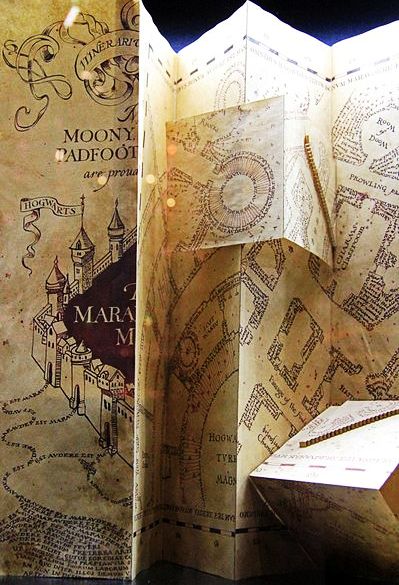
The Marauder’s Map, a prop from the Harry Potter films. Posted to Flickr by Karen Roe.

The Marauder’s Map, a prop from the Harry Potter films. Posted to Flickr by Karen Roe.

Text that moves or changes, appears or disappears is the very stuff of occult fiction. Horror writer M.R. James (1862-1936) uses mystical text frequently in his short satires – a bit of Latin schoolwork with an ominous message which disappears after reading, a slip of paper with runic symbols and a death wish, a scrapbook of medieval manuscripts that imprisons a fearful demon, a will that translates itself from an unknown language to English when in the right hands.**
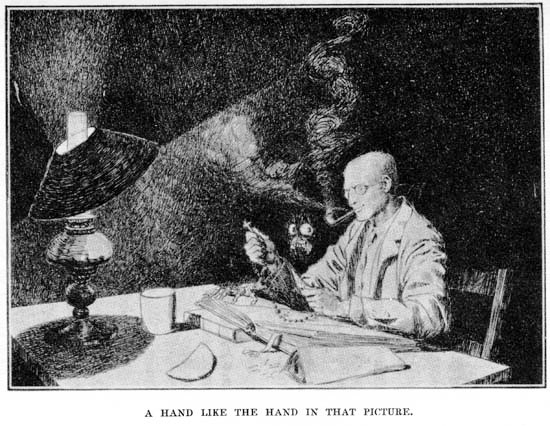
An illustration from an early printing of M.R. James’ “The Scrapbook of Canon Alberic.”

An illustration from an early printing of M.R. James’ “The Scrapbook of Canon Alberic.”

The esoteric nature of magical documents requires that they be difficult to interpret. While the Grimmerie employs movable type and The Marauder’s Map is cloaked in invisibility, other magical books are written in ancient – preferably dead – languages: Latin, Greek, Ancient Hebrew and Arabic are favorites; others are written in code.

Perhaps the most unusual literary spell book appears in Jonathan Strange & Mr. Norell by Susanna Clarke, a novel crammed full of books of magic. The chief among these, the Book of the Raven King, is found written indelibly on the body of a beggar. The text, present from birth, is heavily symbolic, seemingly indecipherable, and subject to alteration:

“I have changed! said Vinculus. “Look!” He took off his coat and opened his shirt. “The words are different! On my arms! On my chest! Everywhere! This is not what I said before!” …..

“So what are you now?”

Vinculus shrugged his shoulders. “Perhaps I am a Receipt-Book!*** Perhaps I am a Novel! Perhaps I am a Collection of Sermons!”

“I hope you are what you have always been – a Book of Magic. But what are you saying? Vinculus, do you mean to tell me that you never learnt these letters?”

“I am a Book,” said Vinculus, stopping in mid-caper. “I am the Book. It is the task of the Book to bear the words. Which I do. It is the task of the Reader to know what they say.”


Fortunately, we readers may leave the burden of interpretation to the authors, sit a spell, and enjoy the story.

*The novel is subtitled “The Life and Times of the Wicked Witch of the West;” the musical is subtitled “The Untold True Story of the Witches of Oz.”

**From “A School Story,” “Casting of the Runes,” “The Scrapbook of Canon Alberic,” and “The Tractate Middoth,” respectively

***A recipe book


Sunday, August 6, 2023

YOU HAVE BEEN WARNED: Book Curses (And Cursed Books)

 Christ’s curse upon the crook 

Who takes away this book.*

Until relatively recently in human history, books and documents were valued both for their contents and for the prodigious effort involved in their creation. Book production in a pre-computer age required a high level of literacy, as well as many hours of monotonous labor, whether that of a stoneworker, metal engraver, scribe or printer’s devil.

It was the custom in some cultures to protect precious works by whatever means available: many medieval libraries chained books their shelves to prevent theft,** private collectors might keep their most valued books in locked chests. Especially rare, illustrated tomes might be bound with their own locking clasps to prevent sticky fingers from helping themselves to a page or two.

An additional layer of protection was afforded by the book curse. There are examples of book curses appended to written records from ancient times. They flourished in medieval Europe where scribes, typically monks, were eager to protect the product of their labor. And they can still be found today!

Classical curses

We all know about the curses of Ancient Egypt. Most good mummy movies (and all of the bad ones) feature dire epigraphs warning against the desecration of temple and tomb. The same principle was applied to valuable documents. A Babylonian king placed a curse on a set of clay tablets back in the 7th century B.C.:

Whosover shall carry off this tablet, or shall inscribe hisname on it, side by side with mine own, may Ashur and Belit overthrow him in wrath and anger, and may they destroy his name and posterity in the land.***

 The above is taken from the definitive work on book curses: Anathema – Medieval Scribes and the History of Book Curses (Allanheld & Schram, 1983), by Marc Drogin. Drogin finds additional examples from classical Greece, written on parchment. But he devotes the bulk of his study to medieval book curses.

Medieval Maledictions

On this subject, Drogin goes to some length to explain how books were made in the era of monastic scribes, illuminated manuscripts, and parchment. With all the resources required to create a single volume, it is no wonder the scribes and their masters were inclined to take drastic measures to protect them. Book curses appeared frequently, generally on the first or last page of a volume as part of the colophon.

Being of a religious bent, these men (and some women) tended to call down the wrath of God on miscreants.

This book is one,

And God’s curse is another;

They that take the one

God give them the other.+

Excommunication from the (Catholic) Church, with the implication of eternal damnation, was an especially popular threat. However, the good brothers were not beyond calling for more earthly torments for those who might undermine their work:

To steal this book, if you should try,

It’s by the throat that you’ll hang high.

And ravens then will gather ‘bout

To find your eyes and pull them out.++

Whether in good Church Latin or in the vernacular of the land, medieval scribes did not hesitate to execrate!

Modern Mayhem

Once Gutenberg’s printing press and its descendants got rolling, books and copies of books became more readily available. Still, the work of setting up type, incising illustrations into metal plates, and manually “pulling” sheet after sheet of paper off a wooden press was no mean feat. Book collectors still sought to protect their acquisitions; by no coincidence, about this time hand-written book curses evolved into printed bookplates.

Bookplates, typically pasted into the front cover of a volume and always incorporating the name of the owner, have remained popular to this day due to their limitless design possibilities. A bookplate may be a simple black and white rectangle proclaiming

Ex-libris John Smith.

Or it may be a more original and ornate design incorporating heraldry, block prints, whimsy, and printed or hand-tinted color.

The central purpose of the bookplate remains the same as that of the book curse: protect the book from theft or unauthorized borrowing! To this end, many folks have designed their bookplates to include a warning to malefactors – with words, images, or both.  The warning may be subtle, or more direct:+++


A Word about Cursed Books

Note that the second book plate above subtly references the Necronomican, H.P. Lovecraft’s “dreaded volume.” The Necronomicon is a cursed book in the sense that anyone who messes with it is pretty much guaranteed to get into trouble. While a book curse offers protection against theft, a cursed book brings calamity to anyone who dares open it.

While we cannot attest to any real cursed books, they abound in literature. Harry Potter and his friends encounter one in Harry Potter and the Chamber of Secrets – a diary containing the malevolent spirit of a young you-know-who. An unsuspecting Harry is warned by the worldly wise Ron of the possibilities inherent in a strange book:

Dangerous?” said Harry, laughing. “Come off it, how could it be dangerous?”

“You’d be surprised,” said Ron, who was looking apprehensively at the book. “Some of the books the Ministry’s confiscated – Dad’s told me – there was one that burned your eyes out. And everyone who read Sonnets of a Sorcerer spoke in limericks for the rest of their lives. And some old witch in Bath had a book that you could never stop reading! You just had to wander around with your nose in it, trying to do everything one-handed.”


When it comes to book curses or cursed books, the lesson is “Borrower Beware!”


* Quoted in Drogin, p. 71.

** Image courtesy of “Reading in Restraint: The Last Chained Libraries” by Allison Meier, May 8, 2014, on Atlas Oscura, http://www.atlasobscura.com/articles/chained-libraries-of-the-world, accessed October 5, 2016

*** Quoted in Drogin, p. 53.

+ Quoted in Drogin, p. 72.

++ Quoted in Drogin, p. 78.

+++ Images courtesy of Blog:” Confessions of a Bookplate Junkie,” http://bookplatejunkie.blogspot.com/2012/09/threats-and-warnings-on-bookplates-part.html, accessed October 2, 2016

This essay was originally published on the blog of the American Bookbinders Museum.